Is it OK to switch formula brands?
For most babies, yes. The American Academy of Pediatrics (AAP) says on its parent site: "For most babies, it is OK to switch between different milk-based formulas, including store brands." The exception it names is a baby on "a specific, highly hydrolyzed" formula. If you are unsure, the AAP says to talk with your pediatrician.
The CDC's page on choosing an infant formula says: "No brand of infant formula is best."
Every formula has to meet the same rules. The FDA says all infant formulas sold in the United States must meet its nutrient specifications. Those set minimum amounts for 29 nutrients.
The CDC lists wanting to "switch infant formula brands or types" as a reason to talk with your child's doctor or nurse. When the AAP was asked whether parents should check with their pediatrician before switching, its answer was "That is a good idea," adding that "for many formulas you can switch to a similar product made by another company including store brand formulas."
What are the main types of formula?
Switching types is where the sources bring a doctor in. The table sums up what the AAP's guide to choosing a baby formula and the NHS page on types of formula say about each one.
| Type | What the AAP says (US) | What the NHS says (UK) |
|---|---|---|
| Cow's milk based | Most formula sold. The milk "has been changed dramatically to make it safe and nutritious for infants." | First infant formula "is usually made from cows' milk that has been treated to make it more suitable for babies." |
| Extensively hydrolyzed | The protein "has already been broken down into smaller proteins." Ask your pediatrician to recommend one if your baby needs it for allergies or other conditions. | Hypoallergenic formula is "suitable from birth but only under medical supervision." For a baby with a cows' milk allergy, a GP will prescribe one. |
| Soy | The AAP sees "few circumstances" where soy should be chosen over cow's milk based formula, and says "soy formulas are not recommended in infants with cow milk allergy." Its bottle-feeding page says soy is "sometimes helpful" for that allergy, but protein hydrolysate formulas are "most often" advised, "because 15% of these infants are also allergic to soy protein." | Suitable from 6 months, but only under medical supervision. |
| Lactose-free | Fine nutrition, but check with your pediatrician before starting it. | Suitable from birth, but only under medical supervision. |
| Specialized | Made for babies with specific conditions, including premature babies. Follow your pediatrician's guidance on amounts, timing and preparation. | Anti-reflux formula is suitable from birth, but only under medical supervision. |
The NHS puts soy, lactose-free and anti-reflux formula under medical supervision, and gives soy a starting age of 6 months. The AAP says to check with your pediatrician before lactose-free or hydrolyzed formula, to follow your pediatrician's guidance on specialized formula, and sees few reasons to choose soy at all.
What might change after you switch?
The AAP points out that "mixing instructions (how much water and formula to add to the bottle) can be different for different formula brands."
Stools can look a little different too. The AAP's page on baby bowel movements says formula-fed stools "usually will be tan or yellow in color" and "should be no firmer than soft clay." Green stools "should not cause alarm." It also says: "Occasional changes in color and consistency of the stools are normal."
Will switching help with gas or crying?
The AAP's bottle-feeding questions page says: "Switching from one milk-based formula to another is not helpful for any symptom. It is also not harmful." It adds that switching "for frequent crying, spitting up or gas is rarely helpful," and: "Don't switch formulas without talking with your child's doctor." The NHS says much the same: "There's no evidence that switching to a different formula does any good or harm."
How long should you give a new formula?
None of the AAP, CDC, FDA or NHS pages we checked gives a set number of days to wait after a regular brand switch. Whether a change is working is a question for your baby's doctor.
Which symptoms need a doctor?
The AAP lists the signs of a true cow's milk allergy as "colic, failure to thrive, vomiting, or even bloody diarrhea." Its page on tummy pain in infants says: "There are no specific tests for milk protein allergy. It is diagnosed based on your baby's symptoms."
- Blood in the stool: "Always mention any blood in your baby's stool to their pediatrician." And "if there are large amounts of blood, mucus, or water in the stool, call your pediatrician immediately."
- Vomiting: the AAP's page on vomiting in infants says to "call your pediatrician immediately" for "Blood or bile (a green-colored material) in the vomit," for "Strenuous, repeated vomiting," and for signs of dehydration such as a dry mouth, no tears, a sunken soft spot or less peeing.
- Rash: the NHS page on food allergy lists "itchy skin or a raised rash" and says to see a GP if you think your child may have a food allergy. It also says "do not cut foods out of your diet without speaking to a GP."
- Weight and drinking: the AAP says to contact the doctor within 24 hours if your baby "Does not seem to be gaining enough weight," and to call or seek care now if your baby "Will not drink or drinks very little for more than 8 hours."
The NHS says to call 999 if a child's lips, mouth, throat or tongue suddenly swell, if they are breathing very fast or struggling to breathe, or if "a child is limp, floppy or not responding like they normally do." In the US the emergency number is 911. The AAP lists "Can't wake up" and "Not moving or very weak" as reasons to call 911 now.
What if you can't find your formula?
The CDC's archived shortage page says "you can switch to another brand, including store brands, if needed," and to "Talk with your child's doctor about alternatives" if your usual brand is unavailable. For specialty formula it says: "If your child uses a hypoallergenic or medical specialty infant formula and you can't find it, consult their doctor about safe alternatives."
Three things the sources warn against:
- Never dilute. The AAP says: "Never water down formula!" It explains that watering it down "is dangerous and can cause nutritional imbalances in your baby and lead to serious health problems."
- Never make it at home. The AAP's page on homemade formula says "Some babies fed homemade formula have been hospitalized for hypocalcemia," which is low calcium. The CDC says "FDA and the American Academy of Pediatrics warn against making homemade infant formula."
- No toddler formula before 12 months. The CDC says babies younger than 12 months "should not be fed toddler milks, drinks, or formulas labeled for toddlers." The AAP says whole cow's milk and dairy alternatives "are not recommended for infants under 12 months of age." The archived CDC shortage page differs here: for babies 6 to 12 months it allows some pasteurized, unflavored whole cow's milk "for a short time (no more than a week) as instructed by your child's doctor."
Where you buy matters as well. The archived CDC page says to "only buy from well-recognized distributors and pharmacies," and the current CDC page relays the AAP's warning against illegally imported formula, such as products ordered online from third-party distributors.
For how to make up and store bottles once you have a tin, see our formula preparation and storage guide.
How Feed Flow helps with this
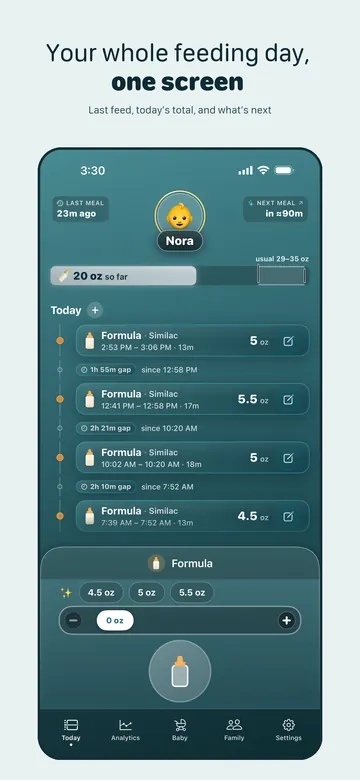
When you change formula, the hardest part later is remembering what changed and when. Feed Flow's formula finder lets you compare products side by side by milk base, protein, stage and vitamin D, using the values on the label, and you can enter your own product. Each bottle you log keeps a record of which formula it used, so the day you switched is right there in the history. You keep a history of the formula or brand used and your baby's response in one place.
Feed Flow does not rank brands, recommend a switch or decide which formula suits your baby. It keeps the record you bring to your pediatrician. More on formula feeding and baby health records.
Sources
- American Academy of Pediatrics, HealthyChildren.org: How should we feed our baby if we're running low on money? (checked November 2026)
- American Academy of Pediatrics, HealthyChildren.org: What should I know about recalled baby formula? (checked November 2026)
- American Academy of Pediatrics, HealthyChildren.org: Choosing a Baby Formula (checked November 2026)
- American Academy of Pediatrics, HealthyChildren.org: Bottle-Feeding (Formula) Questions (checked November 2026)
- American Academy of Pediatrics, HealthyChildren.org: Baby's First Days: Bowel Movements & Urination (checked November 2026)
- American Academy of Pediatrics, HealthyChildren.org: Abdominal Pain in Infants (checked November 2026)
- American Academy of Pediatrics, HealthyChildren.org: Causes of Vomiting in Infants & Children (checked November 2026)
- American Academy of Pediatrics, HealthyChildren.org: Is Homemade Baby Formula Safe? (checked November 2026)
- Centers for Disease Control and Prevention: Choosing an Infant Formula (checked November 2026)
- Centers for Disease Control and Prevention, archived page: Information for Families During Infant Formula Shortages (checked November 2026)
- US Food and Drug Administration: Questions & Answers for Consumers Concerning Infant Formula (checked November 2026)
- NHS: Types of formula (checked November 2026)
- NHS: Food allergy (checked November 2026)