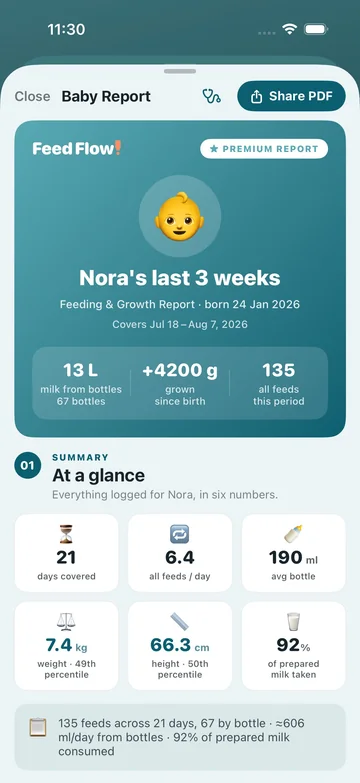
A plain-language percentile example
If a baby is at the 49th percentile for weight-for-age, about 49 out of 100 children of the same age and sex in the reference population weigh less, and about 51 weigh more.
That does not mean the baby is 49 percent healthy, 49 percent grown, or expected to move toward the 100th percentile. Children have different bodies and growth patterns. The 10th and 90th percentiles are not grades either.
Weight, height and head circumference answer different questions
- Weight-for-age places a measured weight in age and sex reference context.
- Length or height-for-age tracks another dimension of growth over time.
- Head circumference-for-age preserves a separate measurement commonly collected in early-childhood care.
Looking at these together is more informative than isolating one reading. Feeding, health, prematurity, genetics, measurement technique and clinical examination can all affect interpretation.
The pattern matters more than chasing a line
A single measurement can vary with scale, clothing, timing or technique. A series of carefully recorded measurements helps a professional understand the pattern. Crossing a percentile line is a reason for a qualified review, not something an app should diagnose.
The WHO Child Growth Standards describe the reference charts and methods. Your country or clinician may use another reference, particularly as children grow older or when prematurity needs to be considered.
How Feed Flow presents growth
Log weight, height and head circumference and see them against the WHO band, with the percentile named. Keep milestones beside those measurements, then use a Baby Report to bring feeding and growth history to a check-up.
The real example screen on this page shows 7.4 kg at the 49th weight percentile and 66.3 cm at the 50th height percentile. Those values belong to the example record; they are not targets for another child.
Do not wait for an app to label a measurement. Contact your pediatrician or child health service about poor feeding, hydration concerns, persistent changes or anything else that worries you.