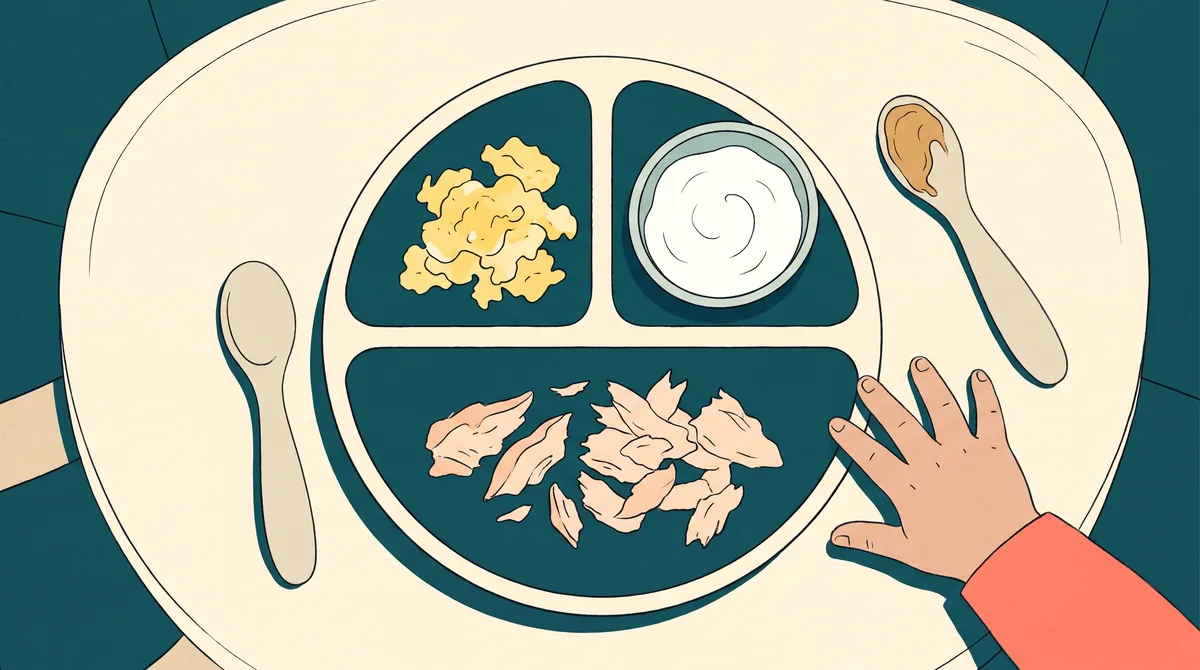
When do the guidelines say to start?
The Dietary Guidelines for Americans, 2025 to 2030 say to introduce potentially allergenic foods, including nut butters, eggs, shellfish and wheat, with other complementary foods at about 6 months. The CDC says to introduce potentially allergenic foods when you introduce other foods.
The AAP's HealthyChildren.org says there is no evidence that waiting prevents allergies once a baby is ready, typically at about 6 months. The NHS says these foods can be introduced from around 6 months, and that delaying peanut and hen's egg beyond 6 to 12 months may increase the risk of an allergy to them.
| Source | What it says about timing |
|---|---|
| Dietary Guidelines for Americans | About 6 months; high risk: ask about peanut as early as 4 to 6 months |
| CDC | When you introduce other foods |
| AAP (HealthyChildren.org) | No reason to suspect increased risk: after a few first foods, peanut ideally as early as 4 to 6 months. Higher risk: pediatrician first, no age given |
| NIAID expert panel (peanut) | Severe eczema or egg allergy: as early as 4 to 6 months. Mild to moderate eczema: around 6 months |
| NHS | From around 6 months, like any other food |
Which babies should see a doctor first?
The peanut guidelines from an NIAID expert panel sort babies into three groups.
- Severe eczema, egg allergy, or both. Age-appropriate peanut-containing food as early as 4 to 6 months. The panel recommends strongly considering a peanut blood test or skin prick test first.
- Mild to moderate eczema. Age-appropriate peanut-containing food around 6 months, which the panel says may be done at home.
- No eczema and no food allergy. Age-appropriate peanut-containing food introduced freely with other solid foods.
The AAP says a baby who has or had severe, persistent eczema, or an immediate allergic reaction to any food, especially egg, is considered high risk for peanut allergy. It gives no age for them, and says to talk with your child's pediatrician first about how and when to introduce highly allergenic foods.
The CDC says that if your child has severe eczema or an egg allergy, talk with your child's doctor or nurse about when and how to safely introduce peanut. The Dietary Guidelines tell every family to ask the baby's health care professional about allergy risk and safe ways to introduce these foods.
The NHS says to talk to your GP or health visitor first if your baby has a diagnosed food allergy or eczema, or if there is a family history of food allergies, eczema, asthma or hay fever.
For babies with severe eczema or egg allergy, the NIAID panel describes peanut as early as 4 to 6 months with allergy testing strongly considered first, the Dietary Guidelines say to talk with your health care professional about peanut as early as 4 to 6 months, and the AAP says to talk with the pediatrician first without giving an age. The NHS page names no age earlier than around 6 months, and asks families with eczema, an allergy or a family history of allergy to talk to a GP or health visitor first.
How do you offer peanut, egg and other allergens?
One at a time, after a few first foods
The AAP suggests starting with a few low allergy risk foods, such as infant cereal or puréed fruit, then one new food at a time, waiting at least a day before the next. It says that if your baby tolerates a few first foods and there is no reason to think they are at increased food allergy risk, you can start the more highly allergenic foods, and that peanut ideally goes to these babies as early as 4 to 6 months. The CDC says to wait 3 to 5 days between each new food. The NHS says one at a time, so you can spot any reaction.
Whole nuts: the age limits differ
- The AAP says whole peanuts and tree nuts are choking hazards, and to avoid whole peanuts until usually at least 4 years and up.
- The NIAID panel says whole nuts should not be given to children under 5. It also says peanut butter straight from a spoon, or in lumps, should not be given to children under 4.
- The NHS page on foods to avoid giving babies says whole nuts should not be given to children under 5. It says nut butter can be spread on a food such as toast, never given on its own.
The AAP and the Dietary Guidelines describe thinning a little peanut butter with breast milk or formula and feeding it by spoon.
Egg
The AAP gives well-cooked egg, scrambled or hard-boiled, as its example. The NHS lists eggs among the foods that can be introduced from around 6 months, and says eggs without the UK red lion stamp should not be eaten raw or lightly cooked.
Cow's milk
The CDC says drinking cow's milk is not recommended until your child is older than 12 months. The AAP says whole cow's milk is not recommended before 1 year of age.
Once a food goes well, does it need to stay in the diet?
The AAP and the NHS both say yes. The AAP says to keep them in the diet routinely, for example about 2 teaspoons of peanut butter or a third of a well-cooked egg. The NHS says that once introduced and tolerated, these foods should become part of your baby's usual diet to lower the risk of allergy.
What does an allergic reaction look like?
The NHS says reactions usually happen within a few minutes, but symptoms can take up to 2 hours. With cow's milk allergy they can take up to 3 days. Among the signs it lists:
- swollen lips or face
- red, itchy, watery eyes
- wheezing and coughing
- a red, itchy rash, or eczema getting worse
- feeling or being sick, tummy pain, diarrhea or constipation
- sneezing or a runny or blocked nose
Most reactions are mild, the NHS says. The AAP says anaphylaxis can start within minutes or several hours, and that infants may also show irritability, fussiness or inconsolable crying.
When do the sources say to call 911 or 999?
The AAP's anaphylaxis page calls anaphylaxis a life-threatening emergency. It says that if epinephrine is available, it should be given immediately to anyone with symptoms of anaphylaxis, followed by a call to 911 (the US emergency number) and a trip to the emergency department. It does not cover the case with no epinephrine.
The NIAID panel's home-feeding instructions for peanut do. Mild signs may be a new rash or a few hives around the mouth or face. More severe signs include lip swelling, vomiting, widespread hives, face or tongue swelling, any difficulty breathing, wheeze, repetitive coughing, pale or blue skin, and sudden tiredness or seeming limp. The panel says that if you have any concerns about your baby's response to peanut, seek immediate medical attention or call 911 (in the US).
In the UK, the NHS anaphylaxis page says to call 999, the UK emergency number, if:
- lips, mouth, throat or tongue suddenly become swollen
- breathing is very fast or a struggle
- the throat feels tight or swallowing is a struggle
- skin, tongue or lips turn blue, grey or pale
- someone suddenly becomes very confused, drowsy or dizzy
- someone faints and cannot be woken up
- a child is limp, floppy or not responding like they normally do
It says to use an adrenaline auto-injector (such as an EpiPen) if you have one, then call 999 for an ambulance.
Once your baby is safe, our reaction diary guide covers what to write down.
How Feed Flow helps with this
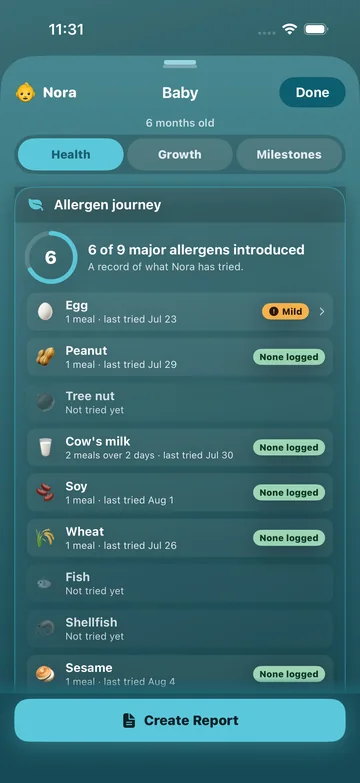
Feed Flow's Allergen journey keeps a record of which allergens your baby has tried. It covers nine major groups: egg, peanut, tree nut, cow's milk, soy, wheat, fish, shellfish and sesame. A ring shows how many you have tried, and each allergen opens to its meals, last attempt and any reaction markers. A reaction note added later stays linked to the meal.
Feed Flow does not tell you when to introduce a food or whether a food is safe for your child, and it does not diagnose allergies. See how solid food and allergen tracking works.
Sources
- NIAID-sponsored expert panel (NIH), Addendum guidelines for the prevention of peanut allergy in the United States, checked November 2026.
- American Academy of Pediatrics, HealthyChildren.org, When to Introduce Egg, Peanut Butter & Other Common Food Allergens to a Baby, checked November 2026.
- American Academy of Pediatrics, HealthyChildren.org, Anaphylaxis in Infants & Children: Responding to Severe Allergic Reactions, checked November 2026.
- Centers for Disease Control and Prevention, When, What, and How to Introduce Solid Foods, checked November 2026.
- US Departments of Agriculture and Health and Human Services, Dietary Guidelines for Americans, 2025 to 2030, checked November 2026.
- NHS, Food allergies in babies and young children, checked November 2026.
- NHS, Foods to avoid giving babies and young children, checked November 2026.
- NHS, Anaphylaxis, checked November 2026.