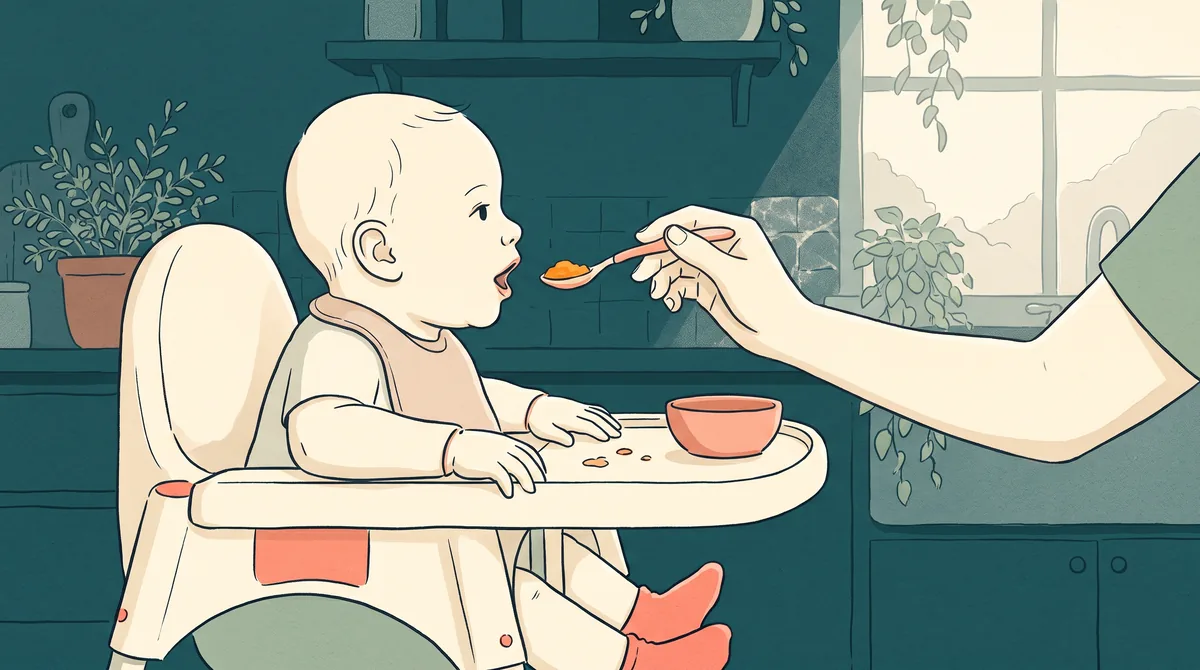
What age do the four authorities give?
All four land on about 6 months. The wording differs a little.
| Authority | What it says |
|---|---|
| CDC (US) | Your child can begin eating solid foods at about 6 months. Introducing foods before 4 months is not recommended. |
| AAP (US) | Only breast milk for approximately 6 months after birth. Readiness depends on each child's own rate of development. |
| WHO | Breast milk only for the first 6 months, then safe complementary (solid) foods from six months. |
| NHS (UK) | Start when your baby is around 6 months old. |
Where they differ: the CDC names 4 months as the floor, and the AAP says babies who have doubled their birth weight (typically at about 4 months) and weigh about 13 pounds (about 5.9 kg) or more may be ready, while the WHO and the NHS simply say from or around 6 months.
If your baby was born early, the NHS says to ask your health visitor or GP when to start.
What are the signs a baby is ready?
The CDC lists these signs. Your baby:
- Sits up alone or with support.
- Can control their head and neck.
- Opens their mouth when you offer food.
- Swallows food rather than pushing it back out onto their chin.
- Brings objects to their mouth.
- Tries to grasp small objects, such as toys or food.
- Moves food from the front to the back of the tongue to swallow.
The NHS boils it down to three: your baby can stay sitting and hold their head steady, can look at food, pick it up and put it in their mouth, and can swallow food rather than spit it back out.
The NHS also names chewing fists, waking in the night more than usual, and wanting extra milk feeds. It calls these normal behaviors, not necessarily a sign that a baby is hungry or ready for solids.
What can be a first food?
There is no fixed order. The AAP says your baby's first foods are your choice, and the CDC, relaying the AAP, says most children do not need foods in a certain order. A few points the sources do agree on:
- Soft and smooth first. The AAP says foods should be soft or pureed to prevent choking. The CDC says thicker, lumpier foods can come as your baby's eating develops.
- Iron and zinc. The AAP says to include foods that provide them, such as baby food made with meat or iron fortified cereals.
- A mix of cereals. The CDC suggests a variety of fortified infant cereals, such as oat, barley and multigrain, instead of only rice cereal. It says feeding only infant rice cereal can increase the risk of arsenic exposure.
- One new food at a time. The CDC and the AAP both say to wait 3 to 5 days between new single ingredient foods.
- Vegetables and fruit. The NHS suggests mashed or soft cooked sticks of parsnip, broccoli, potato, sweet potato, carrot, apple or pear.
- No added salt or sugar. The NHS says not to add either, including stock cubes and gravy.
Do milk feeds carry on?
- The AAP says that at first your baby still gets most of their nutrition from breast milk, formula or both.
- The NHS says breast milk or infant formula should be the main drink during the first year. In the beginning, your baby needs only a small amount of food before their usual milk feed, and does not need 3 meals a day.
- The WHO says to continue frequent breastfeeding up to 2 years or beyond. It gives 2 to 3 meals a day at 6 to 8 months and 3 to 4 meals a day from 9 months.
The NHS puts it kindly: do not worry about how much they eat. Babies have tiny tummies, so a few pieces or teaspoons is a start. If you are wondering about milk amounts, our guide on is my baby eating enough? is a good next read.
Foods the sources say to avoid or limit
This is a selection, not the full lists.
| Food | What the sources say |
|---|---|
| Honey | The CDC says honey before 12 months may cause a severe food poisoning called botulism. The AAP says not to give honey to a baby younger than 12 months. The NHS says wait until over 1 year. |
| Cow's milk as a drink | The CDC says cow's milk before 12 months may put a baby at risk of intestinal bleeding. The CDC also says yogurt without added sugar can come before 12 months. The NHS says cows' milk can be a main drink from 12 months and used in cooking from around 6 months. |
| Juice | The CDC says no fruit or vegetable juice before 12 months. |
| Added sugar and salt | The CDC says children younger than 24 months should not have added sugars, and to avoid foods high in salt. |
Both pages list more. The CDC also covers unpasteurized foods and drinks and fish high in mercury. The NHS also covers raw and lightly cooked eggs, raw shellfish, shark, swordfish and marlin, and some cheeses.
Choking hazards
The CDC's choking list includes:
- Uncut grapes, cherry tomatoes, berries and cherries.
- Hard raw vegetables or fruit, such as raw carrot or apple.
- Whole or chopped nuts and seeds, and spoonfuls of peanut butter.
- Hot dogs, sausages and large chunks of meat or cheese.
- Popcorn, chips, raisins, whole corn kernels and whole beans.
- Hard or gummy candy, marshmallows and chewing gum.
The NHS says whole nuts should not be given to children under 5. The CDC also says to have your child sit up to eat and to watch them at all times while they eat.
Is it gagging or choking?
The NHS says choking is different from gagging, and that babies may gag when solids start. Gagging is part of learning how much food they can manage at once. When a baby is gagging, the NHS says:
- their eyes may water
- they might push their tongue forward, or out of their mouth
- they might retch to bring the food forward in their mouth, or vomit
Choking looks different. The AAP says a child may be choking and need help right away if they:
- can't breathe
- are gasping or wheezing
- can't talk, cry or make noise
- turn a bluish color
- grab at their throat or wave their arms, appear panicked
- become limp or unconscious
In the US, the AAP says to call 911 immediately if your child chokes on something you can't get loose. In the UK, the NHS describes up to 5 back blows for a baby under 1, then chest thrusts, and says to call 999, the UK emergency number, if the blockage doesn't come out. The AAP also recommends taking a certified CPR and first aid course, and the CDC says to talk with your child's doctor or nurse about what to do if your child chokes.
The NHS also says to always stay with your baby while they eat.
What about allergens?
The CDC says to introduce potentially allergenic foods, such as eggs, nut butters and wheat, when you introduce other foods. The NHS says to give them from around 6 months, one at a time and in small amounts so you can spot any reaction. If your baby has severe eczema or an egg allergy, the CDC says to talk with your child's doctor or nurse about when and how to introduce peanut. Our guide to introducing allergens goes through it in detail.
How Feed Flow helps with this
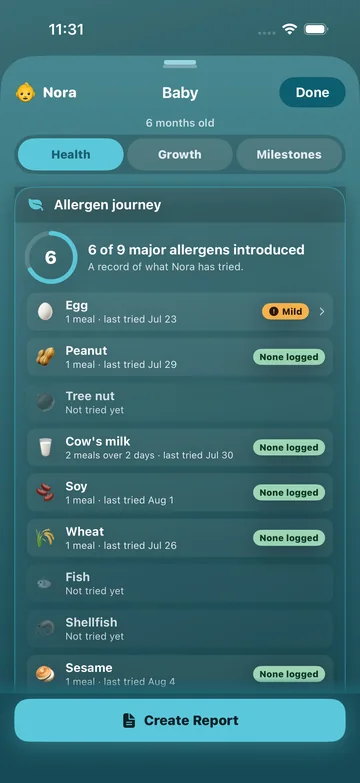
Feed Flow logs solids in the same day's timeline as nursing, bottles and pumping, so you see the whole day in one place. Solids are shown separately from the milk total, so a few spoonfuls of carrot never make the milk number look bigger or smaller than it was.
Allergen foods are also tracked across nine major allergen groups. If you notice something later, you can add a reaction note minutes, hours or days later without losing the original food and its time.
Feed Flow cannot tell you when your baby is ready, which foods to offer, or whether a reaction was caused by a food. It keeps the record. See how solids and allergens work in Feed Flow.
Sources
- CDC, When, What, and How to Introduce Solid Foods, checked November 2026.
- CDC, Foods and Drinks to Avoid or Limit, checked November 2026.
- CDC, Choking Hazards, checked November 2026.
- American Academy of Pediatrics (HealthyChildren.org), When Can Babies Start Solid Foods?, checked November 2026.
- American Academy of Pediatrics (HealthyChildren.org), Botulism, checked November 2026.
- American Academy of Pediatrics (HealthyChildren.org), Choking Prevention for Babies and Children, checked November 2026.
- American Academy of Pediatrics (HealthyChildren.org), When Your Child Needs Emergency Medical Services, checked November 2026.
- World Health Organization, Infant and young child feeding, checked November 2026.
- NHS, Your baby's first solid foods, checked November 2026.
- NHS, Foods to avoid giving babies and young children, checked November 2026.
- NHS, Drinks and cups for babies and young children, checked November 2026.
- NHS, How to stop a child from choking, checked November 2026.