What the signs of enough milk look like
The AAP says nearly all new parents worry about whether their baby is getting enough. The NHS says it may take a little while before you feel confident, and that nearly all women produce enough milk for their baby.
The CDC lists these signs that a breastfed baby is getting enough to eat:
- Breastfeeding often, 8 to 12 times in 24 hours.
- You can see and hear your baby swallowing.
- Your baby seems content after a feed.
- Your baby is steadily gaining weight.
- Enough pees and poops through the day.
The AAP says a well-fed newborn seems satisfied and happy for an average of 1 to 3 hours between feedings.
For bottle-fed babies the CDC says babies generally take what they need at each feeding and stop eating when full. Its signs of fullness are closing the mouth, turning the head away from the breast or bottle, and relaxed hands.
How many wet and dirty diapers by day?
The AAP calls a newborn's diaper a good indicator of whether they are getting enough to eat. This is the CDC's table of minimums for a breastfed baby, per 24 hours:
| Baby's age | Wet diapers (at least) | Poops (at least) |
|---|---|---|
| Day 1 | 1 | 1 |
| Day 2 | 2 | 3 |
| Day 3 | 5 | 3 |
| Day 4 | 6 | 3 |
| Day 5 to day 7 | 6 | 3 |
The numbers differ a little between authorities. The AAP says 6 or more wet diapers a day, with nearly colorless or pale yellow urine, by 5 to 7 days old, and at least 3 to 4 yellow, loose stools a day by then. The NHS says at least 6 heavy, wet nappies every 24 hours from day 5, and from the fourth day at least 2 soft, yellow poos a day for the first few weeks.
Disposable diapers can be hard to read. The NHS suggests adding 2 to 4 tablespoons of water (about 30 to 60 ml) to a clean diaper to feel what wet is like.
When should my baby be back to birth weight?
Losing some weight after birth is expected. The CDC says it is normal for breastfed babies to lose some weight in the first week, and that they should be back to their birth weight by day 10 to 14 of life. The AAP says a well-fed newborn loses no more than 8% to 10% of birth weight in the first few days before starting to gain again.
The NHS says most babies are at, or above, their birth weight by 3 weeks, and a midwife or health visitor will help if a baby has not got there by then. So the US sources say about two weeks and the NHS says three.
After that, steady growth is the long answer. The AAP says your baby's progress on the growth chart is one way to tell whether they are getting enough food, and babies who stay in healthy percentile ranges are probably getting a healthy amount. The NHS says a baby's weight may move up or down by 1 centile line, but crossing 2 lines is less common and worth talking to a health visitor about. Our guide to WHO growth percentiles explains what those lines mean.
Why ounces alone don't answer it for a breastfed baby
With a bottle you can see the number. At the breast you can't, and the AAP says so plainly: if you are breastfeeding, you can't measure exactly how much milk your newborn is taking. Instead it names weight gain, wet and dirty diapers, and how long your baby seems satisfied after nursing as good clues.
The AAP gives a rough picture: most breastfed babies take about 1 oz (30 ml) in the first few weeks, rising slowly to roughly 4.5 oz (about 130 ml) at a year.
The WHO describes breastfeeding responsively, as often as the child wants, day and night, and responding to signs of hunger and fullness. If your milk hasn't come in after 5 days, the AAP says to have your baby weighed by the pediatrician immediately, and calls this the most precise way to tell whether they are getting enough.
Formula ounces don't settle it either. The CDC says every baby is different and to talk with your baby's doctor or nurse about how much formula is right. Our guide to how much formula by age has the amounts the sources give.
Signs a baby may not be getting enough
The CDC lists seven signs for a breastfed baby:
- Breastfeeding fewer than 8 times in 24 hours most days.
- You cannot see or hear your baby swallowing while breastfeeding.
- Trouble staying latched, or clicking sounds during feeds.
- Your baby seems fussy after breastfeeding.
- Still losing weight after day 5.
- Fewer than 3 poops and fewer than 6 pees a day by 5 days old.
- Your baby's skin looks a bit yellow.
The AAP's warning signs include:
- Your baby still seems hungry after most feedings.
- You don't hear frequent swallowing once your milk has come in. The AAP notes you may not hear it in the early colostrum days.
- Feeds consistently shorter than about 10 minutes during the first few months.
- Feeds consistently longer than about 50 minutes.
- By two weeks, your baby is under birth weight or hasn't started gaining at least 5 to 7 oz (about 140 to 200 g) a week since your milk came in.
- After 7 days, fewer than 6 wet diapers and 4 stools a day, urine that is dark yellow or specked with red, or stool that is still dark.
- After 5 days, your milk hasn't come in or your breasts don't feel like they are filling.
Signs of dehydration in a baby
The NHS lists these signs of dehydration in a baby:
- A sunken soft spot (fontanelle) on top of the head.
- Sunken eyes.
- Few or no tears when they cry.
- Fewer wet nappies than usual.
- Being drowsy or irritable.
The AAP adds a dry mouth, playing less than usual, and for infants fewer than six wet diapers a day. Its signs of severe dehydration include being very fussy or excessively sleepy, cool and discolored hands and feet, wrinkled skin, and peeing only one to two times a day.
When to call the doctor
In the US, the AAP says to call 911 immediately if your child can't breathe, has a seizure or loses consciousness, and to call 911 if you're not sure what's wrong but believe your child is in danger. In the UK, the NHS says to call 999 (the UK emergency number) or go to A&E if a baby with signs of dehydration has blue, grey, pale or blotchy skin, lips or tongue, skin that feels cold, difficulty breathing or lots of quick breaths, or is sleepier than normal or difficult to wake.
The AAP says to notify the pediatrician immediately if any warning sign of dehydration develops. In the UK, the NHS says to ask for an urgent GP appointment or call NHS 111 if your baby seems drowsy, has fewer wet nappies, has few or no tears, is breathing quickly or has a fast heart rate, or has a sunken soft spot.
For feeding worries that are not an emergency: The CDC says to speak to your baby's health care provider right away if you are worried about your baby's health. The AAP says that if your baby still seems hungry after most feedings, consult your pediatrician and have them weighed right away. The NHS says to ask for help early and speak to your midwife, health visitor or a breastfeeding specialist.
How Feed Flow helps with this
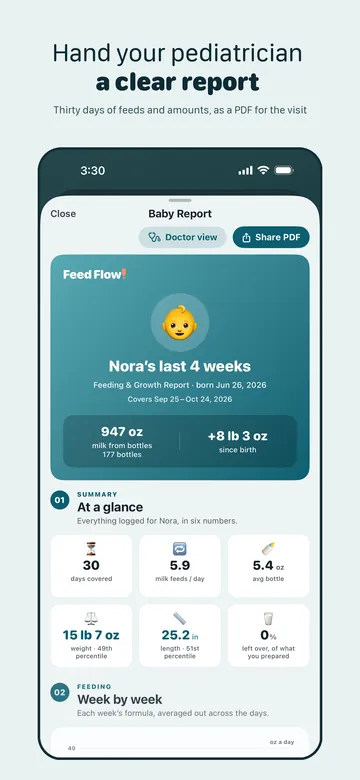
Feed Flow does not judge whether your baby is eating enough. It keeps the record so you and your baby's doctor can look at the same facts. Today at a glance shows every nursing session, bottle, pumping session, water and solids in the day's timeline, with a milk total that counts nursing as an estimate. Weight, height and head circumference can be shown against the WHO Child Growth Standards, with the percentile named (how growth tracking works). A Baby Report turns feeding totals, daily averages and growth into one PDF to bring to a check-up. Feed Flow does not track diapers. Our printable feeding log has a column for wet and dirty diapers.
Sources
- CDC, Newborn Breastfeeding Basics, checked November 2026.
- CDC, How Much and How Often to Breastfeed, checked November 2026.
- CDC, How Much and How Often to Feed Infant Formula, checked November 2026.
- CDC, Signs Your Child Is Hungry or Full, checked November 2026.
- AAP (HealthyChildren.org), How to Tell if Your Breastfed Baby is Getting Enough Milk, checked November 2026.
- AAP (HealthyChildren.org), Warning Signs of Breastfeeding Problems, checked November 2026.
- AAP (HealthyChildren.org), How Often and How Much Should Your Baby Eat?, checked November 2026.
- AAP (HealthyChildren.org), Signs of Dehydration in Infants & Children, checked November 2026.
- NHS, Breastfeeding: is my baby getting enough milk?, checked November 2026.
- NHS, Breastfeeding: the first few days, checked November 2026.
- NHS, Your baby's weight and height, checked November 2026.
- AAP (HealthyChildren.org), When Your Child Needs Emergency Medical Services, checked November 2026.
- NHS, Dehydration, checked November 2026.
- WHO, Infant and young child feeding, checked November 2026.
- WHO, Child growth standards, checked November 2026.