
The short answer
Most newborns eat 8 to 12 times in 24 hours. The CDC gives that number for both breastfed and formula-fed newborns. For breastfed babies in the first days, the CDC says your baby may want to eat as often as every 1 to 3 hours. For formula-fed babies, it says to start with 1 to 2 oz every 2 to 3 hours in the first days.
The sources describe feeding when your baby shows hunger. The AAP says babies "should be fed whenever they seem hungry" and calls this feeding on demand, or responsive feeding. The NHS says to feed your baby as often as they want. The WHO describes breastfeeding as often as the child wants, day and night.
The AAP also sets an outer limit for breastfed newborns. It says a baby should not go longer than about two to three hours during the day, or four hours at night, without a feeding.
There is one exception the AAP names. For babies born early or with certain medical conditions, it says scheduled feedings advised by your pediatrician are best.
How often babies eat, by age
Feeds start close together and spread out as your baby grows. The CDC says the time between feedings will start to get longer over the first few weeks and months.
| Age | Breastfed | Formula-fed |
|---|---|---|
| First days | May want to eat every 1 to 3 hours (CDC) | 1 to 2 oz every 2 to 3 hours (CDC). The AAP says no more than about 1 to 2 oz (30 to 60 ml) per feed in the first week |
| First weeks | 8 to 12 feeds in 24 hours (CDC). The AAP says about every 2 hours, 10 to 12 sessions | 8 to 12 feeds in 24 hours (CDC). The AAP says every 2 to 3 hours, at least 8 |
| End of month 1 and after | In the first weeks and months, most exclusively breastfed babies feed every 2 to 4 hours on average (CDC) | 3 to 4 oz (90 to 120 ml) about every 3 to 4 hours (AAP) |
| 2 to 4 months | No set number in these sources. The CDC says feeds can change with the time of day, and the NHS says cluster feeding usually happens in the first 3 to 4 months | The AAP says most no longer need a middle-of-the-night feeding by now, or once they weigh more than 12 lb (5.4 kg) |
| Around 6 months | Feeds change as solid foods start. Keep following hunger cues (CDC) | 6 to 8 oz (180 to 240 ml) at each of 4 or 5 feedings in 24 hours (AAP). The CDC says formula or solids about 5 to 6 times in 24 hours from 6 to 12 months |
The sources mostly agree. The one small difference: for breastfed newborns, the AAP describes 10 to 12 sessions as the norm, the CDC says 8 to 12, and the NHS says at least 8 times a day for the first few weeks.
For amounts in more detail, see how much formula by age.
How do I know my baby is hungry?
The CDC lists these hunger signs from birth to 5 months:
- Putting their hands to their mouth.
- Turning their head toward your breast or the bottle.
- Puckering, smacking or licking their lips.
- Clenched hands.
The AAP adds sticking the tongue out, rooting (moving the head and mouth in search of the breast), opening the mouth and fussiness. The NHS mentions getting restless and making murmuring sounds.
The CDC says crying is often a late sign of hunger, and the AAP calls it a late sign. The NHS says it's best to feed during the early cues, because a crying baby is difficult to feed.
The AAP adds that not every cry or suck means hunger.
My baby wants to eat every hour. Is that cluster feeding?
It may be. The NHS says cluster feeding is when your baby wants to feed even more often, sometimes constantly, over a period of time. It usually happens in the first 3 to 4 months, during the day, the night or both. The NHS calls it "very normal and nothing to be concerned about."
The NHS says a baby may cluster feed for a few days during a growth spurt, and things settle once your milk supply catches up.
Formula-fed babies cluster feed too. The NHS bottle feeding page says you can cluster feed formula, and to watch for cues that your baby needs a break. Paced bottle feeding is one way families slow a feed down.
Should I wake a sleeping newborn to feed?
In the first weeks, the sources say sometimes yes. The CDC says babies need to eat every 2 to 4 hours at first, so you may need to wake your baby to feed.
- Breastfed babies. The AAP's limit is the one above: about two to three hours by day, four at night. Even if you have to wake them, it says to make sure they get eight to twelve feedings in 24 hours.
- Formula-fed babies. The AAP says that if your baby sleeps longer than 4 to 5 hours in the first few weeks and starts missing feedings, wake them up and offer a bottle.
To help a sleepy baby wake, the CDC suggests patting, stroking, undressing or changing the diaper. If a breastfed baby does not feed when woken, the AAP says to wait half an hour and try again.
The AAP also says that if your baby has trouble gaining weight, don't wait too long between feedings, even if it means waking your baby.
What about night feeds?
The WHO's wording for responsive breastfeeding covers the night too: as often as the child wants, day and night. The NHS says a breastfed baby may want to feed more and for longer at night. That is when the body makes more prolactin, the hormone that makes milk.
For formula-fed babies, the AAP says that between 2 and 4 months, or once a baby weighs more than 12 lb (5.4 kg), most no longer need a middle-of-the-night feeding. None of the sources give a set age for breastfed babies.
When to call your baby's doctor
The AAP has a page of warning signs of breastfeeding problems. Its general advice is to contact your baby's pediatrician. The signs it lists include:
- Your newborn frequently misses nursing sessions or sleeps through the night. The AAP says that if your newborn sleeps longer than 4 hours a night, wake them up and encourage them to nurse.
- Your baby still seems hungry after most feedings. The AAP says to have them weighed right away.
- You don't hear frequent swallowing when your baby nurses once your milk supply has come in. The AAP says that if they don't seem to be swallowing, call their pediatrician right away.
- After 7 days, your baby has fewer than 6 wet diapers and 4 stools a day.
- By two weeks of age, your baby is under their birth weight.
The AAP also says to talk with your pediatrician if your baby seems to want to eat all the time, even when full, or if a formula-fed baby consistently seems to want more or less than the AAP's guide amounts. In the UK, the NHS says to speak to a midwife or health visitor if you are worried about breastfeeding or think your baby is not getting enough milk. For the full list of signs, see is my baby eating enough.
How Feed Flow helps with this
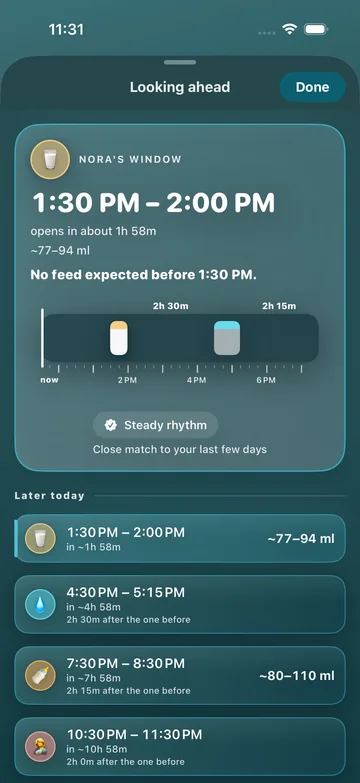
When feeds come every two hours, it's hard to remember when the last one started. Feed Flow keeps nursing, pumped milk and formula in one timeline, so you can see when the last feed was.
After about four days of logged feeds, FlowCast looks at your baby's own history and shows a likely window for the next feed and the day ahead. Once the rhythm is steady, about a week of regular days, it can send a quiet reminder before the next window. It stays silent overnight.
FlowCast is a planning guide. It cannot see a growth spurt, a cold or a cluster feeding evening, and it does not assess hunger. It is meant to be used beside your baby's cues: the app's own guidance is to feed when your baby needs it, whether that is before, during or after the predicted window.
Sources
- CDC: How Much and How Often to Breastfeed, checked November 2026.
- CDC: How Much and How Often to Feed Infant Formula, checked November 2026.
- CDC: Signs Your Child Is Hungry or Full, checked November 2026.
- AAP (HealthyChildren.org): How Often and How Much Should Your Baby Eat?, checked November 2026.
- AAP (HealthyChildren.org): How Often To Breastfeed, checked November 2026.
- AAP (HealthyChildren.org): Amount and Schedule of Baby Formula Feedings, checked November 2026.
- AAP (HealthyChildren.org): Warning Signs of Breastfeeding Problems, checked November 2026.
- NHS: Breastfeeding: the first few days, checked November 2026.
- NHS Best Start in Life: Latching on, checked November 2026.
- NHS Best Start in Life: Cluster feeding (bottle feeding), checked November 2026.
- WHO: Infant and young child feeding, checked November 2026.