
What is paced bottle feeding?
Paced bottle feeding is a way of giving a bottle where your baby sets the speed. You hold your baby fairly upright and the bottle close to flat, so milk only flows when your baby sucks. Your baby can pause, breathe, and stop when they are full.
The USDA calls it paced bottle feeding and says it is sometimes used with breastfed babies. The UNICEF UK Baby Friendly Initiative describes responsive bottle feeding, in its leaflet on infant formula. The NHS uses neither name, but gives similar baby-led advice for any bottle feed. The shared idea: follow your baby's cues instead of the amount left in the bottle.
What the health sources say about it
Each source covers a different part, so here is what each one actually says.
- NHS and AAP: the NHS says your baby will know how much milk they need, and to follow your baby's lead. The AAP says babies regulate their intake from day to day, so let them tell you when they have had enough.
- CDC: the CDC says to hold the bottle at an angle so the milk only comes out when your baby sucks, and to let your baby take breaks when they seem to want them.
- USDA: the USDA says that during paced bottle feeding the baby tends to have more control, so it is similar to breastfeeding. It also says a slow flow nipple helps a baby control how much they eat and can reduce spit ups.
- Academy of Breastfeeding Medicine: in its 2025 model hospital policy, written about breastfed babies who need supplements, the ABM prefers cup feeding. It adds: when bottles are used, “consider paced bottle-feeding, which is more physiologic.”
- UNICEF UK: UNICEF UK says bottle feeding as responsively as possible can help support a close and loving bond between parent and baby.
If you mix breast and bottle, our guide to combination feeding covers the rest.
How to pace a bottle feed, step by step
No single source gives these as one ordered list. These are the steps the sources describe, put together here, with who says each one.
- Before the feed, check the nipple flow. The USDA suggests a slow flow nipple. Turn the filled bottle upside down. Drops should follow each other closely without running in a stream. A stream means the hole is too big, and milk may come too fast.
- Watch for hunger cues. The CDC lists hands to the mouth, turning toward the bottle, puckering or licking lips, and clenched hands. UNICEF UK says crying is the last sign, so try to feed before your baby cries.
- Hold your baby close and semi-upright. The NHS and UNICEF UK both say semi-upright, close enough to see your baby's face. Look at your baby and talk to them as you feed.
- Let your baby take the nipple. Brush the nipple against your baby's lips. When they open wide, let them draw it into their mouth. The NHS and UNICEF UK both describe this.
- Keep the bottle close to flat. The NHS says to keep it horizontal, just slightly tipped. The AAP adds that the milk should cover the nipple, so your baby is not swallowing air.
- Pause when your baby needs a break. UNICEF UK lists signs: splayed fingers and toes, milk spilling out of the mouth, stopping sucking, turning the head, or pushing the bottle away. Gently take the nipple out, or tip the bottle down to stop the flow. The USDA says to burp at natural breaks.
- Switch sides partway. The USDA and UNICEF UK suggest switching the arm you hold your baby in. The USDA says this helps a baby keep enjoying feeding on both sides, which matters when breastfeeding.
- Stop when your baby is done. The CDC says to stop when your baby shows fullness, even if the bottle is not empty. You can offer more if they show hunger again.
The CDC says not to prop a bottle or leave it in your baby's mouth. It can raise the risk of choking, ear infections and tooth decay, and your baby may eat more than they need.
How long should a paced feed take?
The USDA says a typical feeding session will take 15 to 20 minutes “but should be based on the baby’s fullness signs.” The NHS says to always give your baby plenty of time to feed. None of the other sources here give a number.
Signs your baby has had enough
| What you may see | Who lists it |
|---|---|
| Closes their mouth or keeps lips closed | CDC |
| Turns their head away from the bottle | CDC, AAP, USDA |
| Hands and arms relax | CDC, USDA |
| Sucking slows down | USDA |
| Lets go of the nipple | AAP |
| Pushes the bottle away | USDA |
| Gets fidgety or easily distracted | AAP |
| Falls asleep | AAP |
It can go the other way too. The AAP says that if your baby drains the bottle and keeps smacking their lips, they might still be hungry.
Why not push your baby to finish the bottle?
The CDC, NHS, USDA and UNICEF UK say not to force a baby to finish. The CDC says not to force your baby to finish the bottle when they show fullness, because they may eat more than they need. The NHS says forcing more milk can distress your baby and can lead to overfeeding, and not to worry if they do not finish. UNICEF UK says forcing a baby to finish can be stressful for them.
The USDA explains why the amount changes. Babies may eat more during a growth spurt and less when they are sick, tired or just not hungry. It says forcing a baby to finish can lead to unhealthy eating habits and a higher chance of being overweight later.
The AAP does not put it that way. It says to let your baby tell you when they have had enough, and that overfeeding often leads to spitting up and contributes to obesity.
What about the milk that is left? The NHS says to throw away any unused formula or breast milk once you have finished the feed. Our formula safety guide has the CDC time windows, and how much formula by age covers typical amounts.
When to talk to your baby's doctor
The two AAP pages give different upper figures for formula, so here are both.
- Bottle Feeding Basics: talk to your baby's doctor if your baby is taking more than 7 or 8 ounces (about 210 to 240 ml) per feeding, or more than 36 ounces (about 1,060 ml) a day.
- Amount and Schedule of Baby Formula Feedings: babies should usually drink no more than an average of about 32 ounces (960 ml) of formula in 24 hours. If your baby consistently seems to want more or less, discuss it with your pediatrician.
- NHS: talk to your health visitor or GP if your baby is sick after feeds a lot, is violently sick, seems to be in pain, or you are worried for any other reason.
How Feed Flow helps with this
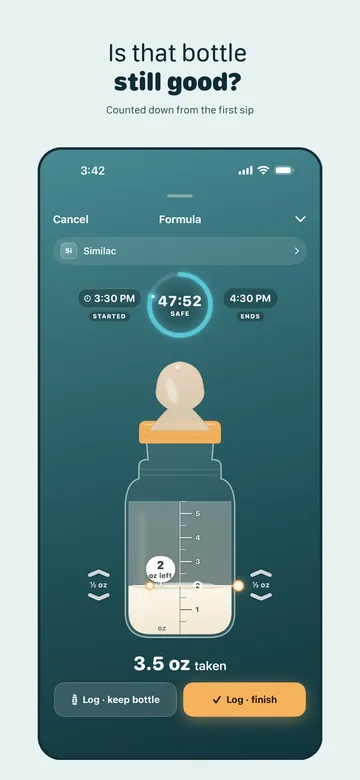
Paced feeding often leaves milk in the bottle, and that is fine. Feed Flow records each bottle the way it really went: what you prepared, what your baby took, and what was left, in ml or oz. You slide a picture of the bottle to show what was drunk and read what is left. After a few bottles, the amounts you usually pour appear as one-tap buttons, so you can prepare closer to what your baby takes. A little milk left in a bottle is normal. Feed Flow is designed to reduce avoidable waste, not to pressure a baby to finish. The app keeps the record. It cannot read your baby's cues or tell you how much your baby should drink. See how bottle tracking works.
Sources
- CDC: About Feeding From a Bottle, checked November 2026
- CDC: Signs Your Child Is Hungry or Full, checked November 2026
- American Academy of Pediatrics, HealthyChildren.org: Bottle Feeding Basics, checked November 2026
- American Academy of Pediatrics, HealthyChildren.org: Amount and Schedule of Baby Formula Feedings, checked November 2026
- NHS: Bottle feeding advice, checked November 2026
- UNICEF UK Baby Friendly Initiative: Infant formula and responsive bottle feeding, checked November 2026
- UNICEF UK Baby Friendly Initiative: Responsive bottle feeding leaflet (PDF, updated November 2024), checked November 2026
- USDA Food and Nutrition Service: Feeding a Baby Using a Bottle and Cup (infant feeding guide for child care, chapter 5, PDF), checked November 2026
- Academy of Breastfeeding Medicine: Clinical Protocol #7: Model Maternity Policy Supportive of Breastfeeding (2025, PDF), checked November 2026