
What combination feeding means
Combination feeding, also called mixed or combo feeding, means your baby gets some breast milk and some formula. NHS Highland in Scotland puts it simply: it is when you breastfeed sometimes and give formula at other times.
The breast milk part can come straight from the breast or as pumped milk in a bottle. The NHS lists several ways to do it: nursing plus bottles of expressed milk, nursing plus formula, or bottles of both.
The WHO and UNICEF recommend breast milk only for the first 6 months, then breastfeeding up to 2 years or beyond alongside solid foods. The AAP recommends breast milk only for about the first six months if possible. The same AAP page also says babies can thrive on breast milk, infant formula or a combination of the two.
Why parents combine breast milk and formula
The NHS says mixed feeding may be a good option if you want to share feeds with a partner or family. It says it may also suit you if you are:
- Mainly breastfeeding but also wanting to offer expressed milk or formula.
- Bottle feeding but wanting to start breastfeeding.
- Going back to work or study and needing bottles while you are away.
- Struggling with breastfeeding and needing to give your baby some formula.
NHS Highland adds that some parents mix feed because they worry they do not have enough milk. If that is your reason, the section on getting enough below is worth a read before you change anything.
How do you start adding formula?
The NHS suggests breastfeeding only for 6 to 8 weeks after the birth first, to give you time to get the hang of it. The AAP and CDC pages we read do not name a set number of weeks.
When you do start, the NHS guide to introducing formula describes going slowly:
- The NHS says you could start by replacing 1 breastfeed a day with a bottle feed.
- Give your body time. After you swap a breastfeed for formula, the NHS says it can take around 5 to 7 days for your breasts to adjust.
- Generally, each breastfeed you drop is replaced with 1 bottle of formula.
For the first bottle, the NHS suggests a time when your baby is calm, not tired or hungry. It also suggests a slow-flow teat and holding your baby the way you would to breastfeed. A baby used to nursing may refuse the bottle at first. The CDC notes that a breastfed baby may take a bottle more willingly from someone other than you. See also our guide to paced bottle feeding.
Breast milk first, then formula
The AAP's page on low milk supply says that if you supplement with formula, start feedings with the breast milk you have first, then give formula if needed. The CDC gives the same order on its page on preparing powdered formula in an emergency. The Academy of Breastfeeding Medicine, in its protocol on supplementing newborns, calls the mother's own expressed milk the first choice for extra feeds.
What does formula do to your milk supply?
The AAP says removing milk well is the best way to keep up your supply. The NHS says introducing formula will probably reduce the amount of breast milk you produce. Longer gaps between breastfeeds tell your body that less milk is needed, especially in the first 6 to 8 weeks.
Whether that matters depends on what you want:
- If you want to keep breastfeeding: the NHS says expressing your milk helps maintain your supply while you top up. The ABM protocol, written for supplementing healthy term newborns, says that ideally mothers express about once for each time the baby gets a supplement, or at least 8 times in 24 hours if the baby is not feeding at the breast.
- If you want to cut down or stop: the NHS says to go gradually, which lowers the risk of mastitis and sore, overfull breasts. Its milk supply page suggests allowing about a week for every feed you drop.
- If you want to breastfeed more again: the same NHS page suggests breastfeeding as often as you can, skin to skin, expressing between feeds and cutting bottles down slowly as supply grows.
Can breast milk and formula go in the same bottle?
None of the NHS, CDC, AAP, WHO or ABM pages we checked gives a direct yes or no on mixing the two in one bottle. Here is what they do say:
- The CDC says to give your baby only breast milk or infant formula in a bottle. That line is about what goes in a bottle at all, not about combining the two.
- The CDC and the AAP both describe giving breast milk first, then formula, as two steps of one feed.
- NHS Highland suggests keeping formula feeds separate from breastfeeds where possible, and using expressed milk in place of formula where you can. That advice is about separating feeds, not bottles.
- The CDC cleaning FAQ warns that germs can grow quickly if breast milk or formula is added to a partially used bottle. That is about topping up a bottle your baby has already drunk from.
Pumped milk and prepared formula also have different storage rules. Our breast milk storage guide and formula safety guide cover each one. If you are thinking of mixing them, your baby's doctor or a lactation consultant can talk it through with you.
How do you know your baby is getting enough?
With nursing you cannot see the ounces, so the signs come from your baby. The NHS signs below are written for breastfed babies. It lists these for a breastfed baby feeding well:
| Baby's age | What the NHS says to expect |
|---|---|
| First 48 hours | Is likely to have only 2 or 3 wet diapers |
| First 3 to 4 days | Losing some birth weight is normal |
| From day 4 | At least 2 soft, yellow poops a day for the first few weeks |
| From day 5 | At least 6 heavy, wet diapers every 24 hours |
| After the first 3 to 4 days | Steady weight gain |
The CDC says babies should seem content and drowsy after feeding when they have had enough. With bottles, the CDC says to watch for signs your baby is full and stop, even if the bottle is not empty. The AAP calls a baby tracking along their growth curve very reassuring. Our guide on whether your baby is eating enough goes deeper.
The NHS says to ask for help early if you have concerns about how much milk your baby is getting, from your midwife, health visitor or a breastfeeding specialist. The CDC says to talk with your baby's doctor or nurse about questions on growth or how much breast milk your baby is getting.
A note on vitamin D
Here the US and UK guidance is written differently. The CDC says babies who get both breast milk and formula need a 400 IU vitamin D supplement every day from shortly after birth. The NHS says breastfed babies need daily vitamin D from birth, but babies having more than 500 ml (about 17 oz) of formula a day should not be given vitamin supplements. That NHS page covers breastfed babies and babies on more than 500 ml of formula a day, and does not address babies who get both. It says your health visitor can give you advice on vitamin drops. Our vitamin D guide has the details.
How Feed Flow helps with this
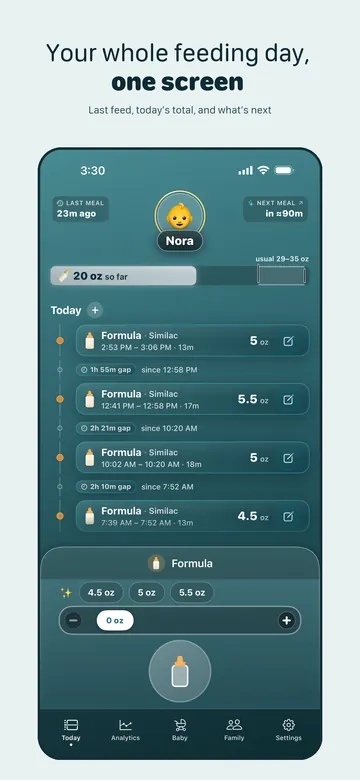
Combo feeding often leaves you with nursing times in one place and bottle amounts in another. In Feed Flow, nursing, pumping, expressed milk and formula go into one timeline. The day's milk total counts formula, pumped milk and nursing, with nursing counted as an estimate, since nobody can see how much a baby drinks at the breast. A partner who gives bottles can log from their own iPhone into the same record.
Feed Flow does not track diapers, does not assess your milk supply and does not tell you how much your baby should drink. See how combo feeding works in Feed Flow.
Sources
- NHS: Introduction to mixed feeding, checked November 2026
- NHS: Introducing formula feeds, checked November 2026
- NHS: Mixed feeding challenges, checked November 2026
- NHS: Top up feeds, checked November 2026
- NHS: Adjusting your milk supply, checked November 2026
- NHS: Breastfeeding: is my baby getting enough milk?, checked November 2026
- NHS: Vitamins for children, checked November 2026
- NHS Highland: Mixed (combination) feeding, checked November 2026
- CDC: How Much and How Often to Breastfeed, checked November 2026
- CDC: About Feeding From a Bottle, checked November 2026
- CDC: Prepare and Store Powdered Infant Formula in an Emergency, checked November 2026
- CDC: How to Clean, Sanitize, and Store Infant Feeding Items: Frequently Asked Questions, checked November 2026
- CDC: Vitamin D, checked November 2026
- American Academy of Pediatrics (HealthyChildren.org): Why We Support Breastfeeding for Your Baby's Health, checked November 2026
- American Academy of Pediatrics (HealthyChildren.org): Low Breast Milk Supply: 5 Steps That Can Help, checked November 2026
- World Health Organization: Infant and young child feeding, checked November 2026
- Academy of Breastfeeding Medicine: ABM Clinical Protocol #3: Supplementary Feedings in the Healthy Term Breastfed Neonate, Revised 2017, checked November 2026