The short answer
Newborns take small amounts. The CDC says to start a formula-only baby on 1 to 2 ounces (30 to 60 ml) every 2 to 3 hours in the first days, and to give more if they show signs of hunger. The American Academy of Pediatrics (AAP) says that by the end of the first month most babies take at least 3 or 4 ounces (90 to 120 ml) per feed, and by 6 months 6 to 8 ounces (180 to 240 ml) at each of 4 or 5 feeds a day.
The AAP also says a baby should usually drink no more than an average of about 32 ounces (960 ml) of formula in 24 hours.
These are typical ranges. The CDC says every baby is different, and how much and how often your baby feeds depends on their needs.
How much formula by age: the table
This table holds only figures the sources tie to an age. Where a page gives only ounces, we converted to ml at 1 ounce to about 30 ml, as the AAP does.
| Age | Per feed | Per day | Source |
|---|---|---|---|
| First day or two | Maybe only ½ oz (about 15 ml) | At least 8 feeds in 24 hours | AAP |
| First days (CDC) | Start with 1 to 2 oz (30 to 60 ml) every 2 to 3 hours, more if your baby shows signs of hunger | Most newborns feed 8 to 12 times in 24 hours | CDC |
| First week (AAP) | No more than about 1 to 2 oz (30 to 60 ml) | Most newborns eat every 2 to 3 hours | AAP |
| By the end of the first month | At least 3 or 4 oz (90 to 120 ml) | About every 3 to 4 hours | AAP |
| 2 to 5 months | Your baby drinks more at each feed as they grow (CDC). Neither page gives a figure for these months. | The time between feeds gets longer (CDC) | CDC |
| By 6 months | 6 to 8 oz (180 to 240 ml) | 4 or 5 feeds in 24 hours | AAP |
| 6 to 12 months (CDC) | No amount given | Formula or solid foods about 5 to 6 times in 24 hours | CDC |
| 8 to 12 months (AAP) | As an example, the AAP's sample menu offers breast milk or 4 to 6 oz formula with meals, and 6 to 8 oz before bed (about 120 to 180 ml and 180 to 240 ml, our conversion) | Roughly 24 oz (720 ml) of breast milk or formula a day | AAP |
| 12 months | The CDC says you can switch from formula to plain, unsweetened, pasteurized whole cow's milk or fortified unsweetened dairy alternatives. | The CDC says you can do this gradually, and you may want to start by replacing one formula feed with cow's milk. | CDC |
The AAP says that no book or website can tell you precisely how much or how often your baby needs to be fed. The table shows what is typical, not a target for each feed.
How much formula per day?
Two AAP rules apply at any age.
| Rule (AAP, any age) | Amount |
|---|---|
| By body weight, on average | About 2½ oz (75 ml) a day for every pound (453 g) |
| Usual maximum | No more than an average of about 32 oz (960 ml) in 24 hours |
The AAP adds that your baby will probably regulate their own intake, so let them tell you when they have had enough. It says there are high and low limits: if your baby consistently seems to want more or less, discuss it with your pediatrician.
The same AAP page gives both 6 to 8 ounces at each of 4 or 5 feeds by 6 months and the 32 ounce usual maximum, and at the top of that range those feeds would add up to more than 32 ounces.
The CDC says that as your baby gradually eats more solid foods, they will gradually need less formula. For 8 to 12 months, the AAP puts formula at roughly 24 ounces (720 ml) a day. See starting solids.
Signs your baby is hungry, and signs they are full
The CDC lists these signs for babies from birth to 5 months.
Signs of hunger
- Puts their hands to their mouth.
- Turns their head toward the breast or bottle.
- Puckers, smacks or licks their lips.
- Has clenched hands.
The AAP adds sticking the tongue out, rooting, opening the mouth and fussiness. The CDC says crying is often a late sign of hunger, and the AAP and the NHS call it a late sign.
Signs of fullness
- Closes their mouth.
- Turns their head away from the breast or bottle.
- Relaxes their hands.
The AAP says a baby who becomes fidgety or easily distracted during a feed is probably finished. A baby who drains the bottle and keeps smacking their lips might still be hungry.
Does my baby need to finish the bottle?
No. The CDC says your child does not need to finish a bottle. The NHS says to feed your baby when they seem hungry and not to worry if they do not finish it.
The NHS says not to force a baby to take more milk than they want, because this may be distressing and can lead to overfeeding. If you want to slow a feed down, see paced bottle feeding.
Signs your baby may be getting too little
- Wet diapers (AAP): 2 to 3 a day in the first few days after birth. After the first 4 to 5 days, at least 5 to 6 a day.
- Wet diapers (NHS): around 6 a day from a few days after birth, wet with clear or pale yellow urine, or feeling heavy.
- Poop: the NHS says that within the first week your baby should pass pale yellow or yellowish brown poo, at least once a day.
- Growth: the AAP says your baby's progress on the growth chart is one way to tell whether they are getting enough. The growth percentiles guide explains how to read one.
The AAP says that if your baby is having trouble gaining weight, you should not wait too long between feeds, even if it means waking your baby. The NHS says that if your baby is under 8 weeks old and has not pooed for 2 to 3 days, talk to your midwife, health visitor or GP, particularly if your baby is gaining weight slowly. See is my baby eating enough?
Signs your baby may be getting too much
The AAP says bottle-fed babies may be more likely to overfeed, because a bottle is faster and takes less effort. They may keep sucking instead of pulling away when full.
According to the AAP, overfed babies can have stomach pains, gas, spit up or vomit. It says it is better to offer less, since you can always give more if your baby wants it.
The NHS says it is normal for babies to bring up a little milk during or just after a feed. It says to talk to your health visitor or GP if it happens a lot, if your baby is violently sick, seems to be in pain, or if you are worried for any other reason. The AAP says to talk with your pediatrician if your baby wants to eat all the time, even when they are full.
Do the US and UK agree?
On cues, yes. On numbers, the AAP and CDC give ounce ranges by age, while the NHS pages on formula feeding give no fixed amounts. They say "The amount will vary from baby to baby" and point to weight gain and diapers instead.
How Feed Flow helps with this
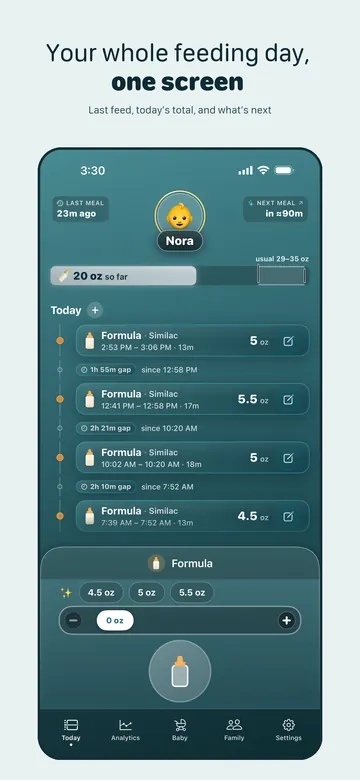
Feed Flow keeps the count for you. Today's milk total adds up formula, pumped milk and nursing, with nursing as an estimate. Each bottle records how much your baby took and how much was left, in ml or oz, so a half-finished bottle is logged as what it was. After a few bottles, the amounts you usually pour appear as one-tap buttons, which you can turn off in Settings.
Feed Flow does not diagnose, set targets, tell you how much your baby should drink or grade a feed. It keeps a record you can bring to your pediatrician. See formula feeding in Feed Flow.
Sources
- American Academy of Pediatrics, HealthyChildren.org: Amount and Schedule of Baby Formula Feedings, checked November 2026
- American Academy of Pediatrics, HealthyChildren.org: How Often and How Much Should Your Baby Eat?, checked November 2026
- American Academy of Pediatrics, HealthyChildren.org: Sample Menu for a Baby 8 to 12 Months Old, checked November 2026
- Centers for Disease Control and Prevention: How Much and How Often to Feed Infant Formula, checked November 2026
- Centers for Disease Control and Prevention: Signs Your Child Is Hungry or Full, checked November 2026
- NHS: Formula milk: common questions, checked November 2026
- NHS: Bottle feeding advice, checked November 2026